

The Problem to Solve: I want a GPS dog tracker that doesn’t rely on cellular networks or Bluetooth.
Here’s the context: Kristy and I go outside with our dogs a lot. Several times per week, we’re out on trails or in places with limited cell service.
Our dogs are either on leash or have excellent recall. We don’t need hunting-style collars to show us that our dogs are running a county over; we just need a secondary option in case they chase a deer and are now lost one ridge over.
So, let’s solve that problem!
Sounds fairly straightforward with all the dog collar trackers that are on the market, right? Not exactly. They all have fundamental limitations OR are exorbitantly expensive.
If you’re not a huge nerd and would rather have a quick summary instead of a write-up, here’s the TL;DR: Using a couple hundred dollars in off-the-shelf radio components, I made a dog tracker that should, in theory, work anywhere in the world without the need for any outside network.
“Anywhere in the world” is a slightly dubious statement because you’d potentially have to get components that are made for your region—but you can order those from the same companies.
Why Other Trackers Fall Short
There’s two (or maybe three) basic tiers of dog trackers on the market:
“Airtag” style options that are cheap but require close proximity to work. These fail even in the scale of my backyard.
The accessible competition: Fi, Halo, and Tractive-style options that all require cellphone network signal to actually work.
True GPS-enabled dog trackers made for hunting. Garmin is the head of this. To get one receiver and one collar, you’re looking at $1000+
Most of them fall short for my use for one simple reason: they require a cell phone network to operate. Even in our nearby towns, cell service can be spotty. In the places we often go hiking like Giles County, Craig County, and Monroe County, WV, these cellular trackers might as well be useless.
So, the options are cellular-based collars that won’t work when we need them or very expensive Garmin collars that are simply overkill for the occasional “maybe my dog will chase a deer” situation.
Enter, a solution!
How “Meshtastic” Works
Meshtastic is “off-grid communication for everyone”, which sounds like some doomsday HAM radio stuff—which it kinda is. You don’t need an amateur radio license, though.
As simply put as possible, Meshtastic is a project that allows you to connect many radios (nodes) together to send text messages and positioning data over LoRa radio. No cellular network or outside infrastructure required.
The goal of many Meshtastic projects is to have a bunch of people with nodes around town, to create a mesh that lets you bounce your signals by “hopping” across their nodes.
That’s tough because you first need to convince a bunch of people on this fringe technology, to buy a cheap node, and to actually turn it on.
In order to make a dog tracker, though, all I need is a small network: my node, my wife’s, and a tracker on our dog.
Implementation
While the tracking setup was a bit finicky to set up (I had to factory reset one node a couple times to get location to report), it’s about as plug-and-play as any open source projects can be.
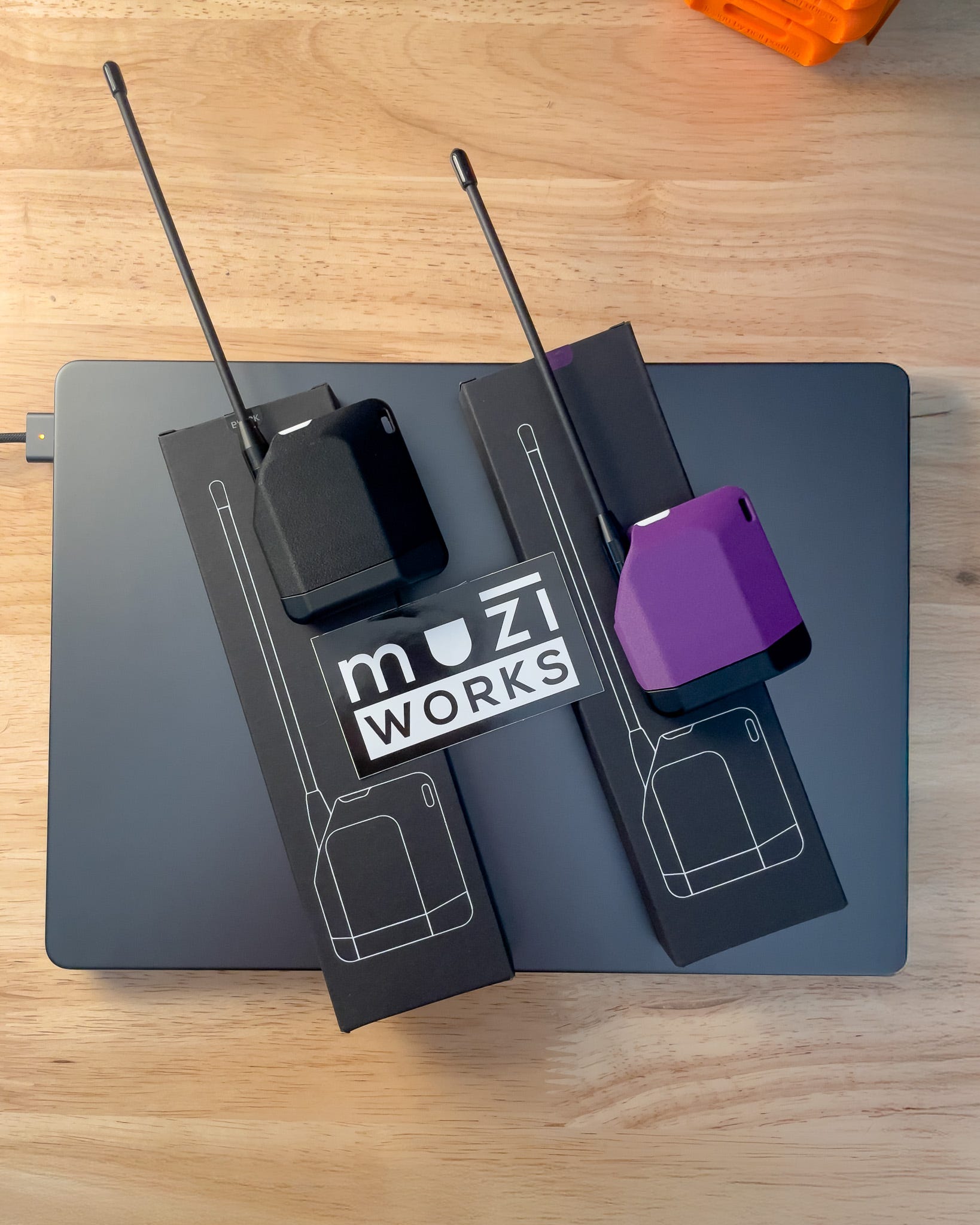
We purchased three “nodes”:
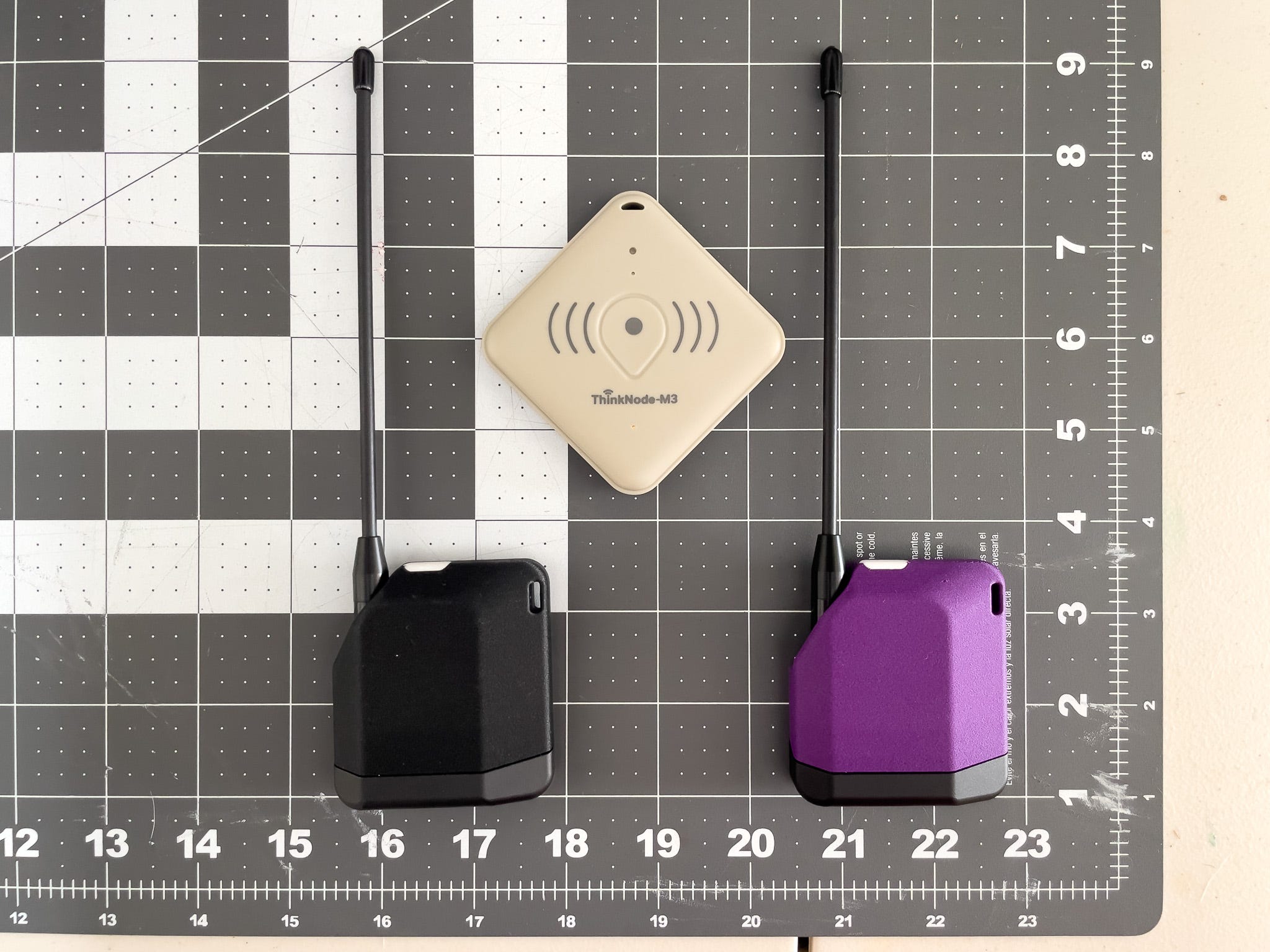
Two Muzi Works R1 Neo nodes.
One Elecrow ThinkNode M3 Meshtastic tracker—which is a node in itself but in a smaller package and with some additional configuration and sensors.
Note: I got the R1 Neo nodes because they have built-in GPS modules. That isn’t very relevant for this project since you could just pull that data from your phone. You could get cheaper radios like a complete Heltec V3 and have this work too.
Each of these nodes have onboard GPS modules so they can connect with satellites and transmit their location data across the radio network, at a set interval. The tracker node sends its position more often (every 30 seconds) and the other nodes update every couple minutes.
Using “Channel 0” that allows you to send your precise location and an encryption key that’s shared as a QR code to add more nodes to a channel, each of these nodes is basically “paired” together and will share its location with each other.
This information is all sent to the Meshtastic app, available for iOS, Android, and desktop. The nodes interface with each of our iPhones via Bluetooth and do not require any cellular service to work.
With a node in each human’s pocket and a tracker on our dog (zip-tied with a bracket on his collar), we can plot our locations on a map, included in the Meshtastic app, and receive updates from the tracker node in “real enough” time: about every 30 seconds.
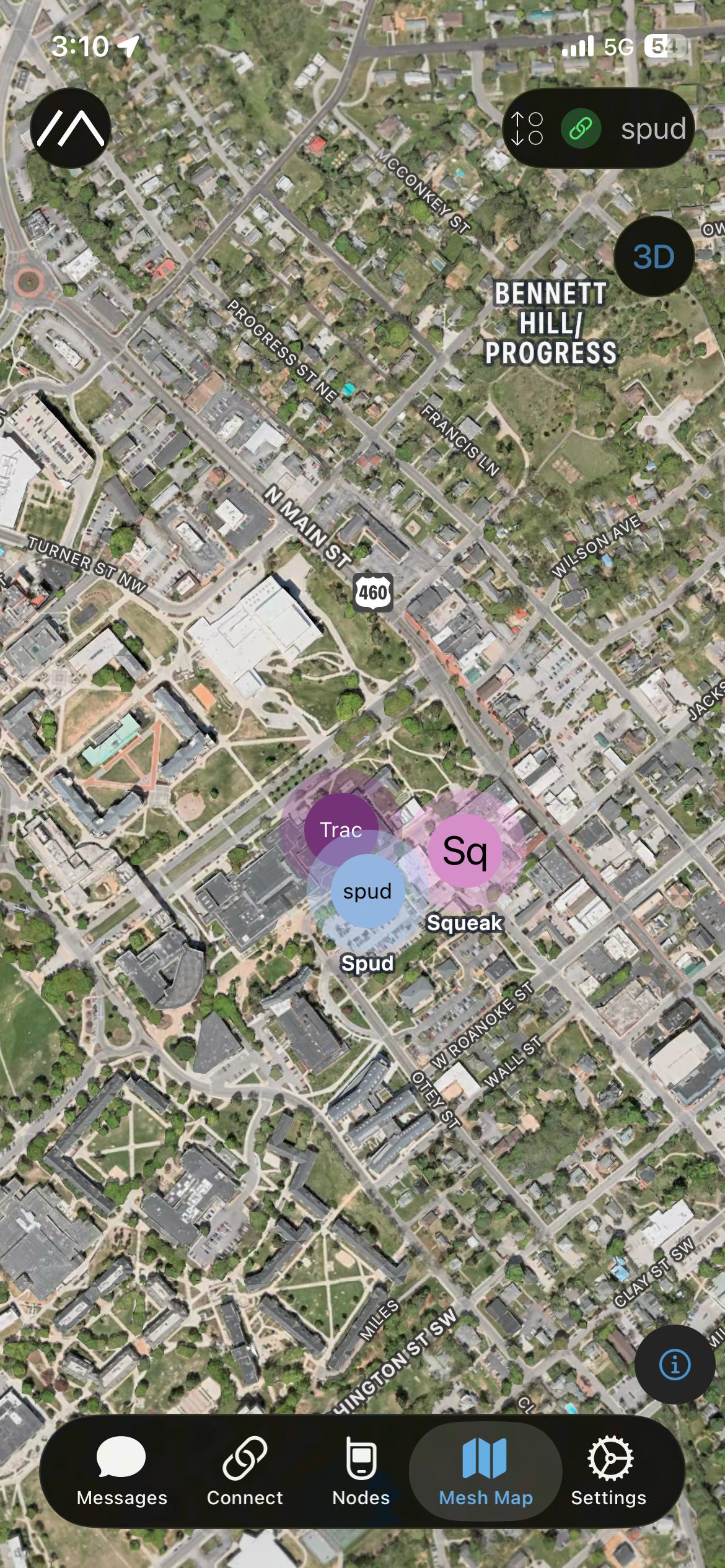
“Squeak” and “Spud” are the nodes we have in our pocket and “Trac” is the dog tracker.
After we were confident that the nodes were reporting as we walked through the Virginia Tech campus, we tried something else: I walked away and Kristy kept our dog with her.
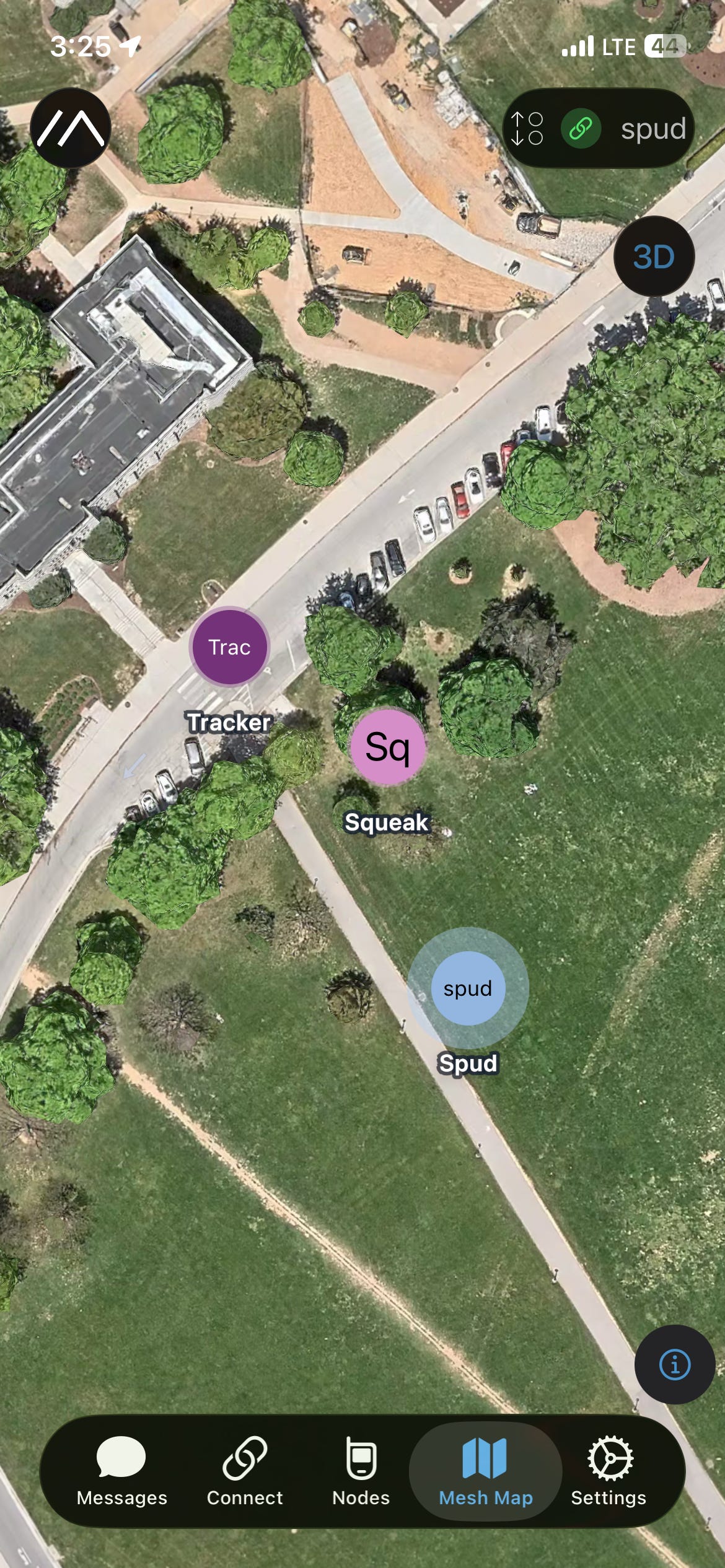
Within the time it took me to walk a few meters onto the drillfield, the Meshtastic app updated our positions and realized I was walking away.
Note: “Squeak” and “Trac” were actually together. The “Squeak” node simply updates less often than “Trac” is set to do. While this isn’t truly real-time, it’s fast enough that we could find our dog in the woods.
There you have it!
Subscription-less, off-grid (no cell network required) GPS dog tracking for less than the cost of most competitors collars.
Limitations/Next Steps
As with any project, this isn’t without limitations:
The radios need to have decent line-of-site to each other.
Each node needs charged AND the radios that my wife and I have in our pockets need a phone as well. That’s a lot to keep charged.
End-of-the-day, it’s relying on an open-sourced app that isn’t nearly as clean and sleek as what Garmin has to offer. That’s still a better product at a lot higher price.
“Will this work if our dog actually runs off?” We’ll see. Airtags and cell-based collars have failed in the past. The plan is to not have him run off in the first place, using a leash.
“Is it plug-and-play? Can I do this if I’m not into tinkering?” As with all technology stuff, I think you can! But I’m often reminded that I’m a lot more willing to read and play around than most people.
This was an incredibly “plug and play” solution in regards to using off-the-shelf radios and an app with no coding required.
“Can I use this as a tracker for my child/bike/family?” You could absolutely use this to track people or things if you were going for a hike or out on your property. The limitation is battery life: the tracker node has a stated battery life of 18 hours.
This is not an Airtag replacement to hide in a camera bag or bicycle. Airtags work better for that because they stay charged for months and if something gets lost or stolen, it only has to show up once to be “found”.
This was a fun winter project with some fairly inexpensive components.
Regardless of how often we’ll actually use this, these radios and the Meshtastic project in general is very fun.
This allows me to make subscription-less things at a time when the world only wants to supply subscription-based solutions. Figuring this out felt like the “old” internet: buggy, a little confusing, and fulfilling in the end.